
25 May 2013
  Welcome Guest
  Login | Help
Home
 
General Information
Transaction Series
Related Information
Connect with WIT Press
Connect with WIT
Login
Login ID:
Password:
 
Your Cart
There are 0 items in your cart. [View]

Adobe PDF Reader is required to view our papers:
Get Acrobat Reader


  Welcome to the WIT eLibrary

The home of the Transactions of the Wessex Institute collection, providing on-line access to papers presented at the Institute's prestigious international conferences and from its State-of-the-Art in Science & Engineering publications.

Paper Information

Derivative computation in the dual reciprocity method

Author(s): W. Toutip, A.J. Davies and M.C. Bartholomew-Biggs

Abstract:
The dual reciprocity method provides a boundary integral technique for solving boundary value problems with source terms.

As such it is an attractive alternative to techniques such as finite differences or finite elements. Unfortunately, normal derivative values are frequently calculated much less accurately then are function values.

Various approaches have been proposed in other boundary element situations viz multiple nodes, discontinuous elements and the gradient method.

The gradient method works particularly well with the dual reciprocity method and gives improved flux values over a wide variety of linear and non-linear problems. 1 Introduction The boundary element method for the solution of homogeneous elliptic boundary-value problems, in which the boundary-value problem is replaced by an eq...

Pages: 10
Size: 677 kb
Paper DOI: 10.2495/BE000551


Download the Full Article

Price: US$ 0.00

This article is part of the WIT OpenView scheme and you can download the full text Adobe PDF article for FREE by clicking the 'Openview' icon below.

conference

Send this page to a friend. Send this page to a colleague.


This paper can be found in the following book

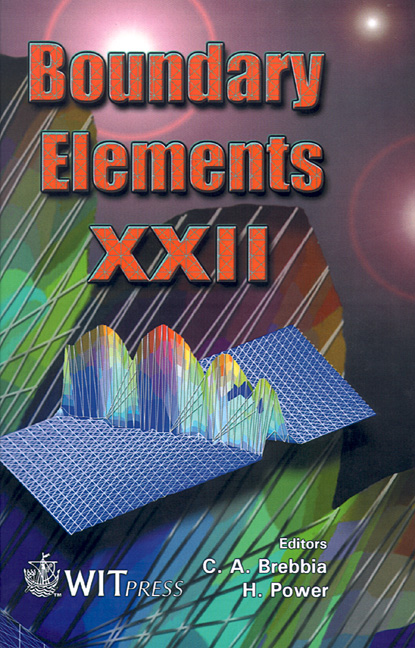
Boundary Elements XXII

Boundary Elements XXII

Buy Book from
Witpress.com


Download the Full Article

This article is part of the WIT OpenView scheme and you can download the full text Adobe PDF article for FREE by clicking the 'Openview' icon to the right.


Copyright© 2006 by WIT Press | About Prof Carlos Brebbia
Optimised for Microsoft Internet Explorer